Infrastructure, not a service retainer.
Most marketing partners hand you a report. The Engine hands you a system — landing pages, nurture sequences, and attribution that live under your brand and keep working whether or not anyone is actively managing a campaign that month.
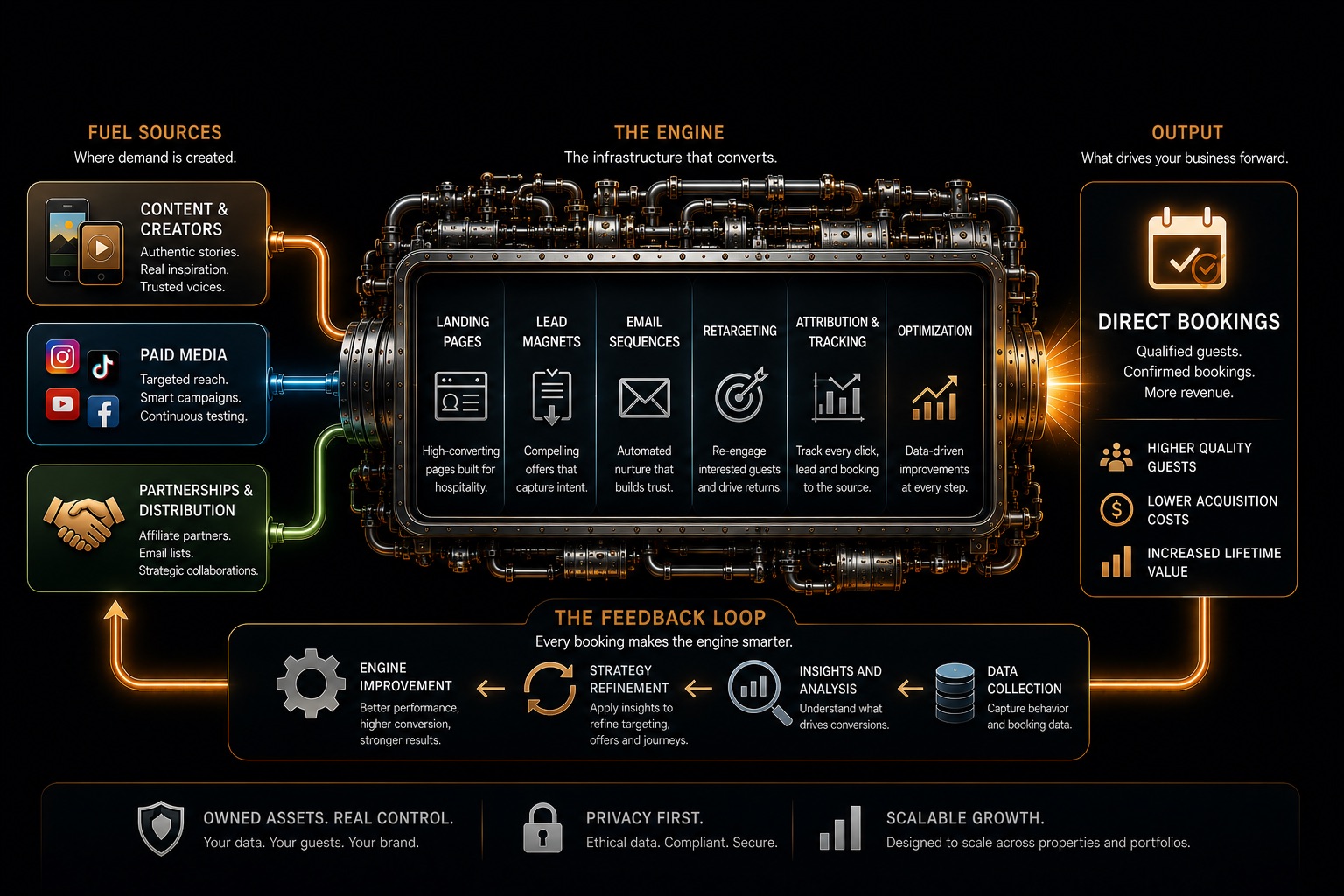
The same system, in detail
The diagram gives you a line each. Here's what every piece is actually doing, and why it's there.
Content & Creators
Creator content sits at the very top of the funnel — it's what makes someone want to stay at your property before they've started shopping for a room at all. Every creator we work with carries a link tied to them personally, so their work isn't filed under "exposure": it's a measurable source. When a piece produces qualified leads, you know which creator and which post, and so do they. That's what keeps them iterating instead of delivering a set number of posts and moving on.
Paid Media
Targeted campaigns, primarily on Meta, built around creative that has already proven itself organically. Putting budget behind an untested concept is how most hospitality ad spend disappears; putting it behind a piece that has already produced leads is a different proposition entirely. Because the Engine tracks past the click, campaigns are judged on the leads they generate rather than on platform-reported engagement.
Partnerships & Distribution
Affiliate partners, email lists, and collaborations — channels that already hold the audience you want. Each partner gets its own tracked source, so a collaboration either earns its place in the mix or it doesn't, and you'll know which within a single season rather than arguing about it at renewal.
Landing Pages
Pages built for one property and one campaign, hosted under your own brand. The job is deliberately narrow: take someone arriving from a reel or an ad and give them a reason to leave their details rather than bounce to an OTA to compare prices. Built around the questions a guest actually has before committing to a stay, answered in the order they tend to ask them.
Lead Magnets
Most people who fall for your property aren't ready to book the day they find it — a high-consideration stay takes six to eight weeks to decide on. A lead magnet gives them a reason to identify themselves now instead of disappearing: a guide, an offer, early access to dates. It converts anonymous interest into a contactable person, which is the hinge the whole system turns on.
Email Sequences
Once someone is in, an automated sequence keeps the property present across the weeks it takes them to decide, without anyone on your team having to remember to send anything. This is the patient, unglamorous part of the funnel, and it's the part most properties skip — which is precisely why so much genuine interest evaporates somewhere between discovery and booking.
Retargeting
People who already visited and showed intent are the warmest audience you will ever have access to. Retargeting brings them back rather than paying again to find someone new. And because the Engine knows what each visitor actually did, it can be aimed at behaviour rather than sprayed at everyone who happened to touch the site.
Attribution & Tracking
The component that makes every other one honest. Every link carries an identifier, every visit and lead is recorded against it, and the chain holds across the full decision window rather than expiring at a platform's reporting cutoff. When a booking lands, it traces back to the campaign, the creator, and the individual piece of content that set it off. This is the capability nothing else in the stack has, and it's the reason the rest of the system can be improved rather than guessed at.
Optimization
With attribution in place, improving the system stops being a matter of opinion. You can see which landing page converts, which lead magnet actually earns the address, which sequence holds attention, and which creative brings the right guest rather than simply the most clicks. Changes get made where the evidence points — and the effect of each change is itself measured.
Direct Bookings
Bookings that arrive through your own funnel, on your own site, with no commission taken out of them. The same guest, booked directly, is simply worth more to you — and the relationship begins with you rather than with a platform that owns the correspondence and rents you access to it.
Lower Acquisition Cost
Once you know what a booking cost to produce, you can decide what it's worth spending. Most properties can't answer that question, so they either underspend on the channels that work or keep paying commission on guests they had already earned. Attribution turns acquisition cost from an estimate into a number.
Increased Lifetime Value
A guest who booked direct is a guest you can contact again — the email address is yours, not an intermediary's. Repeat stays, off-season offers, and referrals all depend on owning that relationship, and none of them cost anything like what winning a new guest costs.
What "attributed" actually means
Most hospitality marketing breaks at the same place: a creator posts, bookings tick up, and nobody can say which of those two facts caused the other. Platform dashboards report on the platform's own slice — they can't see what happened after someone left the ad and landed on your site three weeks later.
The Engine closes that gap by owning the chain end to end. Every creator link and every campaign carries its own identifier. When a visitor arrives, the Engine records it. When that visitor becomes a lead, the lead carries the source with it. When the lead becomes a booking, the revenue is traced back to the specific piece of content that started it — through a decision window that routinely runs six to eight weeks.
What you own at the end
- Your guest data. The email list, the lead history, the booking record — under your brand, exportable, yours if we stop working together.
- Your funnel. Landing pages and nurture sequences that keep running in Maintenance Mode at a fraction of active-management cost.
- Your attribution history. Which creators, which content, and which campaigns produced revenue — the record that makes next year's spending decisions obvious instead of speculative.
Why there's a feedback loop in the diagram
Because we never had one. We spent years making content for hotels with no way of knowing which pieces worked, which meant no way to make more of the ones that did. The loop isn't a diagram flourish — it's the part of the job that was missing, built in deliberately. That's the whole reason this exists.
Privacy, deliberately
The Engine is built on first-party data collected under your own brand, not stitched together from third-party tracking. That's an ethical position, but it's also a durable one: first-party infrastructure doesn't break when the next platform changes its tracking rules.
Ready to own the relationship, not rent it?
Tell us about your property — we'll walk you through where the Engine fits.